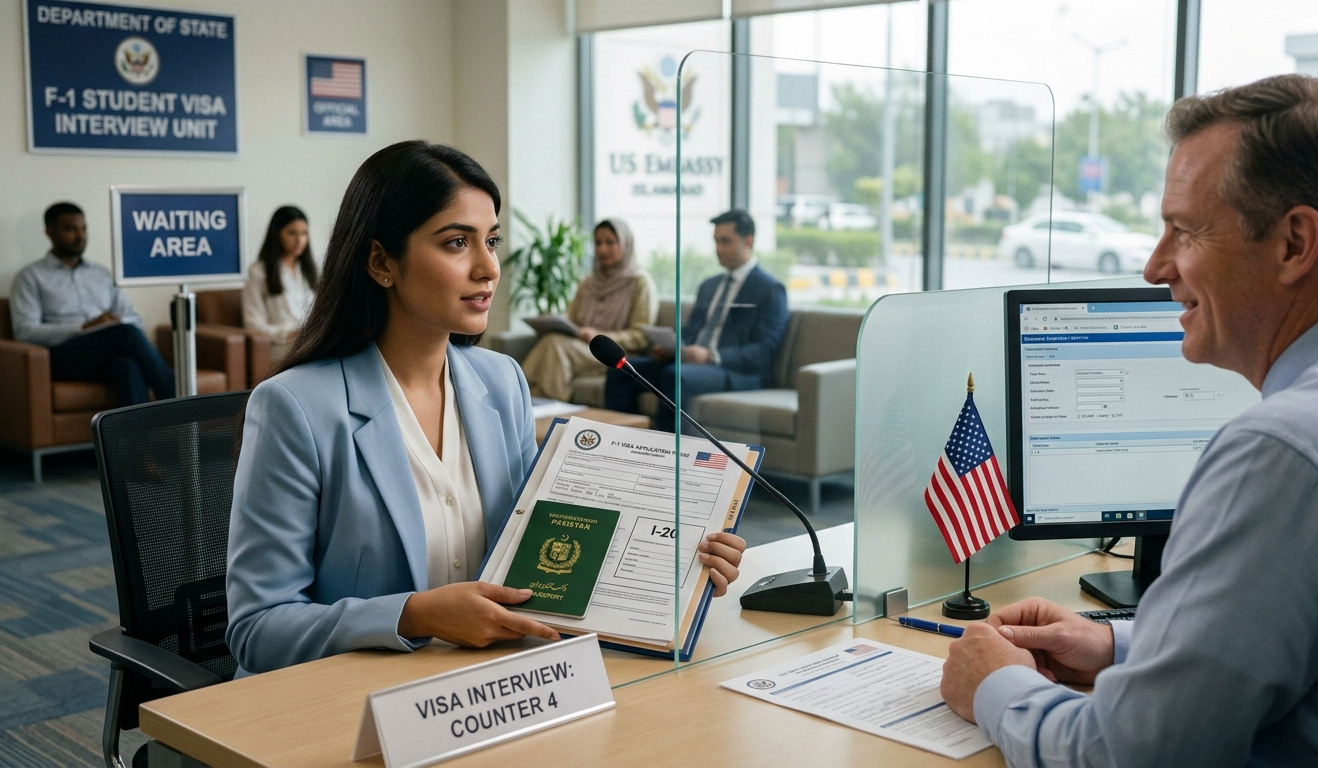
Securing admission to a prestigious United States university is a massive milestone, but there is still one final, crucial hurdle to cross: the F-1 Student Visa Interview.
The visa interview at the US Embassy or Consulate can be a nerve-wracking experience. It typically lasts only 2 to 3 minutes, meaning you have a very short window to convince the visa officer that you are a genuine student with legitimate financial backing and clear intentions to return home after graduation.
As immigration policies and scrutiny evolve in 2026, being thoroughly prepared is more important than ever. This step-by-step guide covers the core pillars of the F-1 visa interview and provides the most common questions along with high-scoring sample answers.
The 3 Pillars of a Successful F-1 Visa Interview
Before looking at specific questions, you must understand what the visa officer is evaluating. Every question they ask falls under one of these three categories:
- Academic Readiness & Intent: Are you a qualified student who genuinely wants to study, or are you just using a student visa as a shortcut to immigrate to the US?
- Financial Capability: Do you or your sponsors have enough liquid funds to cover your tuition fees and living expenses without needing unauthorized illegal work in the US?
- Ties to Your Home Country: Do you have strong social, economic, or family ties that will compel you to return to your home country after completing your degree?
Step 1: Essential Checklist (Documents to Carry)
Before walking into the embassy, ensure your document binder is perfectly organized. Arriving with missing paperwork can lead to an immediate 221(g) refusal or delay.
- Primary Documents: Valid Passport, Form I-20 (signed), DS-160 Confirmation Page, SEVIS I-901 Fee Receipt, and Visa Appointment Confirmation Letter.
- Financial Documents: Original bank statements (last 3–6 months), loan approval letters, sponsorship letters, and income tax returns of your sponsors.
- Academic Documents: University acceptance letter, original transcripts, degree certificates, and standardized test scores (IELTS, TOEFL, GRE, or GMAT).
Step 2: Common Questions and Expert Sample Answers
Category 1: Academic Plans & University Selection
Q1: Why do you want to study in the United States instead of your home country?
- The Strategy: Focus on the high quality of education, practical research opportunities, and global recognition of US degrees that your home country might lack in your specific field.
- Sample Answer: “The US offers an unparalleled hands-on curriculum for Data Science that blends theoretical machine learning with corporate case studies. While my home country has good universities, they lack the advanced cloud computing lab facilities and practical research infrastructure available at [University Name].”
Q2: Why did you choose this specific university?
- The Strategy: Avoid generic answers like “It is a highly ranked school.” Mention specific professors, research labs, or course modules that align with your career goals.
- Sample Answer: “I chose [University Name] because its Master’s program offers a specialized track in Cybersecurity. I am particularly excited about the prospect of learning under Professor [Name], whose recent research on network vulnerabilities aligns perfectly with my thesis goals. Additionally, the university’s state-of-the-art tech incubator provides the ideal environment for my academic growth.”
Category 2: Financial Funding & Sponsorship
Q3: Who is sponsoring your education, and what do they do?
- The Strategy: Be specific about the source of income. Give a clear figure or professional designation rather than vague terms.
- Sample Answer: “My education is being fully funded by my father. He is a Senior Project Manager at [Company Name] and earns an annual salary of $[Amount]. Our family has also maintained a dedicated savings fund of $[Amount], as shown in the bank statements, which comfortably covers my entire tuition and living expenses for the duration of the program.”
Q4: Your I-20 shows a high cost of living. How will you manage unexpected inflation or expenses?
- The Strategy: Demonstrate financial security by showing that your sponsors have surplus liquid assets beyond the minimum required amount listed on your I-20.
- Sample Answer: “Apart from the liquid funds required for my first year, my sponsor holds additional diversified investments, including fixed deposits and property assets. Our family budget accounts for inflation, ensuring that my academic journey remains completely uninterrupted.”
Category 3: Career Goals & Ties to Home Country
Q5: What are your plans after graduation?
- The Strategy: Crucial Step. You must express a clear intent to return home. Mention specific job titles, industries, or family businesses waiting for you in your home country.
- Sample Answer: “Immediately after completing my degree, I plan to return to my home country to join firms like [Local Tech Firm Name] as a Senior Systems Architect. The booming tech infrastructure sector in my country is currently facing a severe shortage of US-trained professionals, and this degree will give me a competitive edge to fast-track my career at home.”
Summary of Dos and Don’ts for 2026
| Dos | Don’ts |
| Keep Answers Short: Answer directly in 2–3 sentences. | Don’t Memorize Scripts: Sound natural; conversational tones build trust. |
| Speak Clearly in English: Be confident and maintain eye contact. | Don’t Say You Want to Settle in the US: Never mention a desire to permanently stay or work there. |
| Know Your I-20 Details: You must know your exact tuition, major, and address. | Don’t Argue: If the visa officer interrupts you, remain respectful and listen. |
Final Tips
The F-1 student visa interview is not an interrogation; it is simply a verification process. By ensuring your documents are immaculate, knowing your financial limits, and demonstrating a genuine passion for your chosen academic field, you can walk into your interview with complete confidence. Prepare thoroughly, stay calm, and clear your path to studying in the USA in 2026.